
|
![]() |
|
HIGHWAY ENGINEERS' REFERENCE BOOK 1947
MANUFACTURERS' DATA
ELECTRIC LIGHTING
REVO ELECTRIC CO., LTD., TIPTON, STAFFS.
|
|
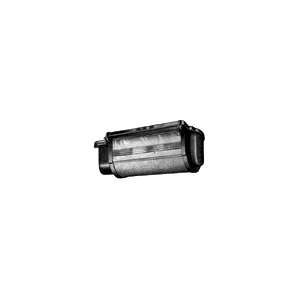
C.12662
This lantern for 140-watt Sodium lamp is of die-cast aluminium alloy and, being enclosed, is very
simple to maintain. Highly efficient light distribution is obtained by means of reflectors and
refractors, 95 per cent. of the lantern output being emitted in the lower hemisphere.
|
|
|
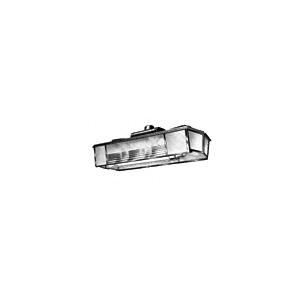
C.12962
This lantern was primarily designed to serve thoroughfares where some degree of colour discrimination is desirable.
The lantern comprises a combination of two standard Tungsten Filament Lamps with a Sodium lamp. It is usual to employ two
150-watt pearl Tungsten lamps with one 140-watt Sodium lamp, thereby obtaining satisfactory colour rendering for normal purposes.
The additional of the tungsten lamps greatly enhances the general appearance of an installation and enables street ligting to be
provided at a low running cost.
|
|
|
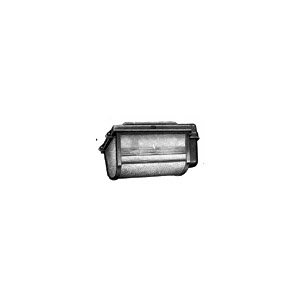
C.12628
The special feature of this die-cast lantern is the independent control of the light by a pressed aluminium
reflector system, in conjunction with glass panels. There are two reflectors on each side of the linear light source, viz., an
upper reflector, which redirects light through the plain upper section of one of the glass panels, and an auxiliary lower
reflector which directs light through the prismatic section and prevents light direct from the source being transmitted through
the plain section.
By this arrangement a highly effective utilization of the total light available is obtained.
|
|
|
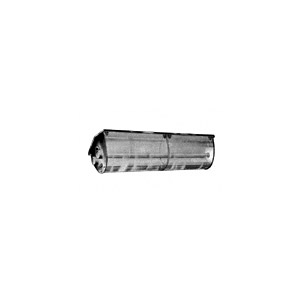
C.12492
One of the outstanding recent developments in street lighting is the use of fluorescent tubular discharge lamps.
This "Sol-etern" lantern is designed for two 5-ft. 80-watt lamps and will give excellent results when spaced and sited in
accordance with the recommendation of the Ministry of Transport Final Report (1937) for Group "A" Roads.
Other lanterns for three or four 5-ft. 80-watt lamps are also available, where higher standards of lighting are required, while
for Group "B" roads smaller types are made for two 2-ft. 20-watt or two 2-ft. 40 watt lamps.
|
|
|
The REVO Electric Company now produce four types of lamp standards - two in artifical stone and two in
tubular steel. The first two (Myron and Phidias) are designed for Groups A and B street lighting,
the second two (Valiant and Vanguard) for Group B lighting. Alternative bracket fixtures are provided
for the Phildias and Valiant.
All standards and brackets have been passed by the Royal Fine Arts Commission.
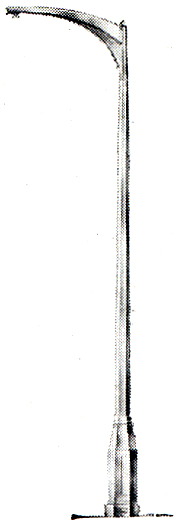
REVO Phidias standard
|
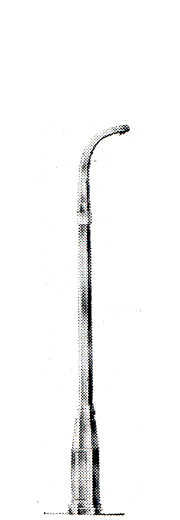
REVO Myron standard
|
|
|
|
