| ||
| ||
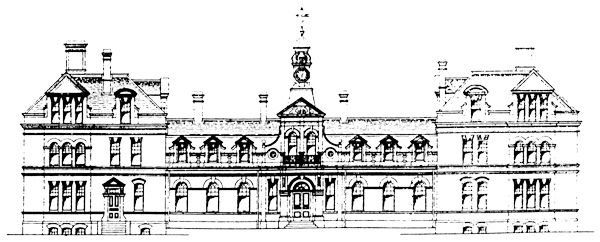 What do you do with old websites? I'd been remembering: publishing urban exploration stories on Facebook, reminiscing with other explorers and talking about the old days. Those days of the fun Canadian Red Cross Memorial Hospital; or old grand old Severalls; or of the Queen of them all, the mysterious and beguiling Cane Hill. And the question came up: "What do you do with old websites?" Do you simply keep them? Or do you add to them? Or do you update them? Or do you let them die? Or do you transform them? You transform them! With the fresh hindsight of twenty years, these old explorations become a historical repository and an archive of ideas, the ultimate source for a book. And with new wisdom, experience and perspective, these old adventures become the rudiments of something different, something which dares to step off the physical beaten track, something that looks at the metaphysical and mystical. Over ten years ago, I tried to collect my thoughts and summarise what happened. But I floundered; it was too early, it had too narrow a scope and it was too analytical. I nailed the idea with the title but failed for follow through. Many picked up on that title and saw its promise and potential, but I couldn't then fulfil it. It's now over twenty years since the iconic and ground breaking Grand Tour. And so I'm dusting everything down, revisiting my photographs and narrations, and thinking everything afresh. I am now back within the dirty, derelict confines of a derelict lunatic asylum in South London. I'm now writing "The Cult of Cane Hill."
 As part of the preparation for the book, I'm going to finish the on-line breakdown of the various parts of the hospital. I'd like Cane Hill to become the most documented asylum on the Internet. If you'd like your pictures included then please get in touch and I'll endeavour to get them added. I'd also be very interested to hear about your experiences of Cane Hill – in particular the ambience, the vibes, the general aura about the place. There is a general feeling that there was something 'special' about it, which is one of the main ideas I'm exploring in the book – so it'll be most welcome to hear your views. Email me: simon@simoncornwell.com
|
||
| ||
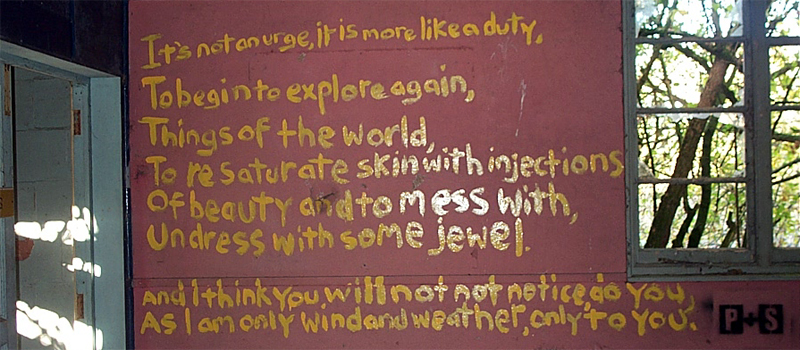
It is more like a duty, To begin to explore again, Things of the world." This was the first line of a graffito - executed confidently and fairly competently - on the wall of a lost and forgotten RAF camp. I don’t normally photograph graffiti, but for some reason, this scrawl struck a chord, so I took a hurried shot. It became an uncaptioned illustration on a backwater website page, never signposted or commented on, but simply left as a placeholder. And it slowly garnered recognition, with murmurs of general approval and nodding acceptance. Even Bradley Garrett, writing his PhD on urban exploration, queried its source. He asked if I'd written it, prompting me to finally determine its progeny: it's 'Kid of Harith' by Will Oldham. But who painted it and why? Imagine the scenario: someone crept into this abandoned building to daub the decaying walls with the lines of an obscure song and, then, simply left it to nature and the wrecking ball. They expected it to eventually succumb and disintegrate with no affirmation or recognition. It was a work of absolute purity – done for its own sake. And then I took this photograph and immortalized it. I believe it was simply a message from one urban explorer to another, a proto-manifesto plucked from the lines of a forgotten song. The only people who would stumble upon it would be like-minded souls and its message would resonate. And it certainly did.
|
||
| ||
|
Dr Tom Stockman has used some of my pictures of Warley to illustrate
A History of the Essex Lunatic Asylum. This three-part
blog is well worth a read.


I was also recently interviewed by Lisa Haushofer for the Remedia Project: The History Of Medicine In Dialogue With Its Present. You can read the interview here.


If asked, explorers can usually tell you the bits of Cane Hill which are still there... but they normally forget the tunnels which are now slipping back into total obscurity. Time to open a correspondence section then.


"I hope this reaches you. This evening I have come across your documentation of Cane Hill, quite by chance, on the whim of attempting to rediscover the photographs of this place I used to pour over in my teens." "I am devouring your words. Your written accounts are utterly gripping, and your musings on urban exploration completely enlightening. I was involved in the periphery of urbex around 2008-2009. It is fascinating to hear first hand accounts of the movement in its infancy, and of Cane Hill as its legend as you so eloquently state." "There is no doubt the place lives on as a recent myth. To my young self, hundreds of miles north of its intoxicating chambers, the hospital was a brooding presence I longed to experience." "Doing so vicariously through your writing and photographs now is perhaps yet more haunting than having traversed the building's rotting fathoms myself." "Thank you for this record. Its value is inestimable."
"Best wishes, 


Memories of Wheal Jane and its last day operating have been added to its section.


Paul Finn has written in with his memories of Long Grove Hospital
|
||
| ||
|
The previously overgrown and neglected Netherne Cemetery has now been cleared.
Check out the postscript to the original 2006 exploration to see the latest pictures.
Has the mystery of Uplands/Whitefields at long last been solved?
The RAF Wyton Photographic Factory is the building that refuses to die. Since my last visits, the western wing has been demolished but the southern and eastern wings remain standing - at this rate, the whole site will be levelled by around 2034. Chris Player has written in with extra information about the facility and the use of some of the rooms. So, I've included his e-mail on its main page, and also updated the descriptions of rooms W10, W13, S1, S4, W8 and W3.
My first trip to Graylingwell has now been written up. It was a failure and my write-up explains why it failed. But it laid the groundwork for a subsequent visit and was a perfect day for exploring and recording the exteriors of the hospital buildings.
|
||
| ||
|
My Pyestock website is now complete. The last write-ups included
documentation of threee of the smaller buildings around the site. The bulldozers have also moved in and
Pyestock is now being demolished - so soon there will be nothing to see.


My next article for CR5 Magazine was about the design of Cane Hill. I'm currently writing the next piece about the early history of the hospital for their July issue.
|
||
| ||
|
Cells 1&2 are the last test cells to be documented on my Pyestock site. And as my work on
Pyestock now comes to an end (with only the CECA Drying Plant and New Fitting Shop to document), the physical site itself
has also reached the end of its life. The bulldozers have moved in and in a year's time there won't be anything left of this remarkable site.
I have begun writing a series of articles for CR5 Magazine about the history of Cane Hill. The first was published in their February edition and has been reproduced here. These articles will be added to the Cult Of Cane Hill which I will now start working on again now the Pyestock website is almost finished.
|
||
| ||
|
Cell 3 West is the penultimate altitude test-cell to be documented
as my Pyestock site moves towards completion. There's also some extra documentation, archive pictures
and information about some historical documentaries which feature the site.


Last week, I appeared on the BBC Radio Bershire's Breakfast Show with Andrew Peach where I was able to give a brief run down about urban exploration and its ethics before defending the scene against the Major Of Windsor who was having problems with alledged petty thieves at one of his properties.
|
||
| ||
|
The largest testing cell at Pyestock, the massive
Cell 4, has now been written up. The description includes
exteriors of the cell building, a partial exploration of the interior of the
Dry Air Main, a thorough photographic record of the cell and the various rooms
and corridors within the building.


John recently wrote in about working at Aquila from 1968 through to 1987.
|
||
| ||
|
The documentation of Pyestock continues with a detailed walk through
Cell 3. This cell is much bigger than the small buildings scattered on
the surface suggest as the majority of the cell was built underground. Luckily it was easy, back in 2006 and 2007, to walk the entire length of cell underground - although I expect everything's flooded now.
|
||
| ||
|
The push to finish the Pyestock website continues - a detailed walk around the iconic Air House has been
added to the site. Note that these photographs were taken in the halycon days of 2007 when the site was relatively unscathed and
equally unprotected. Both these factors have now changed.
|
||
| ||
|
All of the Pyestock Documentation has now been published on my
Pyestock Website. The
Engine And Component Test Facilities - Issue Three booklet is now on-line, and features
archival information about component testing in the Plant House and the endurance testing
in the Admiralty Test House.


An update to the RAF Upwood exploration details how many of the buildings were used for schooling in the 1980s and 1990s.
David Wilson Homes have produced a series of Interpretation Boards for the Rauceby Hospital site. These included images from this website and can be seen here. Steve has also been around the former hospital site and taken photographs of Orchard House before its demolition. A plan of Orchard House has also been added to the maps section. He's also sent in a newspaper cutting of the water tower demolition.
|
||
| ||
|
"I have chanced upon your website that documents the tours of Aquila and Pyestock. It is strange that you have visited two places
that had such a profound influence on my life so far. I was an apprentice at Aquila from September 1980 until September 1985.
I worked at Pyestock as Engineering Manager in Cell 3W for a short while and then for a longer period in Cell 3 in the period
Jan 1995 to Nov 1999." "I think that the building in Pyestock that you describe as the power station was in fact the cold air turbine. This was connected to a 5MW alternator but the aim was to expand compressed air to produce cold, dry air for altitude conditions; electrical power was a by-product. The main air compressors were much bigger with the eight in the air house in the order of circa 27MW each. From memory exhauster numbers 9 & 10 were a bit smaller than the original compressor / exhausters." "I have enjoyed looking through the pictures from your first five visits to Pyestock. Unfortunately the links for visit 6 & 7 do not seem to work". "It is a fact that I was very lucky to have worked at this site when it was THE benchmark test facility of its kind. I have no doubt that there are cheaper ways to produce the engine performance data these days but I doubt that we learn as much from those methods! It is a real shame that we will never see this type of engineering in the UK again. The political decisions that lead to closure were wrong. The commercial case for keeping the Pyestock plant running was very real; GE wanted to test a programme of engines in Cell 3W beyond the scheduled closure. The reason it closed was (in my view) due to the poor choices made by some ill-informed people during the formation of Quinetiq from DERA." "The excellence that was developed at centres like EQD Aquila and NGTE Pyestock came from investment in good people that had bold visions that served the needs of our country. The reasons they closed is because a few individuals did not have the appetite to manage risk and harness technical excellence for the greater good. Those individuals chose their personal wealth and "honours" over the on-going needs of our nation. Because of their poor decisions we have fewer options for our young people to really learn and experience and practice engineering excellence in the UK." "I left Pyestock before the closure and have gone onto work with a number of large blue-chip multinational companies. I have experienced work in FMCG and service sectors. None of the corporations that I have worked for have demonstrated the vision and innovation that was clearly evident in the British Government when they were investing in the MoD research facilities and apprenticeships. But the UK Government bet that the market new best and let the corporate decision makers take over! I firmly believe that the cost saved by closing those MoD blue sky programmes was a fraction of the wealth that would have been generated by investing in their on-going operation. The accounting methods that ended these programmes based on balance sheet risk neglected to take appropriate account of the opportunity cost resulting from their demise." "Please excuse my rant but I find it very difficult to forgive those that neglect the value that Engineering should play in our economy. A recent article in the Times presents the case more eloquently than I could: www.mappingbritishbusiness.co.uk." "Thank you for the documentary of your adventures" - Andy
Peter has recently photographed the remains of Great Barr Hall which I've added as a added as a postscript to the original exploration.
A postscript has been added to the Netherne Cemetery exploration along with a new map section which shows where the cemetery is. (It's difficult to find being some distance from the former asylum).
Steve has tracked down a Historic Landscape Assessment of Rauceby Hospital which was conducted in 2000. Whilst parts of the document are missing, enough remains to learn more about the landscaping of the hospital grounds, the history of the hospital itself, and how much of Goldring's plans were actually implemented.
The main Pyestock site has been updated; the Media and Pyestock Diaries sections have both been completed. Two of the Pyestock diaries can also be found here: Whatever You Just Pressed, Unpress It! and Magpie Abuse |
||
| ||
|
Another major section is completed with RAF Wyton Photographic Factory. This is a photographic
survey of the unique photo processing facility built at RAF Wyton to process the film taking by flown spying missions in the cold war.
To my knowledge, this was a unique cold war structure and so deserves mapping and photographing. I've also written up my last trip to the factory with Tom.


An update to the the ever popular Aquila concerns the old projectors used in the cinema. Whilst John wrote in about nursing in the last years of Long Grove.
|
||
| ||
|
Local paper This Is Croydon Today ran a full page spread on the
recent fire at Cane Hill. Sympathetic to the loss of the Administration Block, it reports on the distress caused to
the residents of Couldson as the iconic clock tower is lost. Interestingly, it mentions the police are
not treating the fire as suspicious. Further additions have been made to the whole Cult Of Cane Hill, some of which are from the old section, and some of which are new.

The next additions to the Hellingly Hospital section include more archival documents and the start of the archival pictures section.
And The Rauceby Virtual Asylum continues to grow with more pictures taken of the hospital just before closure.
|
||
| ||
|
There have been addditions made to St. Margaret's and
the Rauceby Virtual Asylum (which I've spruced up and check out the archival
photograph on the front page).
The destruction of Cane Hill’s Administration Block by fire yesterday was a simple, inevitable footnote in the sad demise of the buildings. When English Partnerships decided to demolish most of the complex and leave a scattered handful of "interesting" buildings in its wake, they effectively sealed the building’s fate. Isolated with no future, the locally listed structure was now either going to fall into ruin or be consumed by fire. The outcome of both is bound to be the same: the structure will be declared unsafe and demolished. In more financially secure times, English Partnerships would’ve shrugged their shoulders and continued with their regeneration of Coulsdon Town Centre (which is why Cane Hill was demolished). However, their merger into the Home and Communities Agency, has left them as exposed as the poor Cane Hill Administration Block; the bloated useless quango will, hopefully, go up in flames in the coalition’s metaphorical bonfire. A fitting end.
Here's the start of a new section to cheer you up.
This section was prompted by the huge amount of archival material collected by Peter Aitkenhead concerning the former East Sussex Asylum. Therefore we visited the main asylum in 2008 to take pictures of the buildings before their demolition; and in doing so, ensured we completed the historic record of this former institution. |
||
| ||
|
The secret of running a website for many years (and this isn’t my longest running endeavour) is knowing when to put it
on a back burner for a while and simply get on with something else. This has been the case with urbex|uk and I’ve
now returned with recharged batteries and renewed vigour. In doing so, I’ve found the energy to complete the Warley section. Although not as extensive as the coverage of Rauceby, it offers a thorough insight into the institution and the state of the building before the conversion started with gusto. The area is has been rechristened Clements Park in an attempt to shake off the old asylum ghosts and local stigma; I’m not sure how successful that will be but the Warley section offers a unique photographic record of how it ended its years as a hospital and before its conversion into luxury apartments.
Part three of the Goldilocks Triumvirate wraps up our adventures on a sunny February Saturday: Uxbridge Lido.
I noticed with a shudder of Schadenfreude that the Home and Communities Agency, which partly comprised old friends English Partnerships, has ended up on the tinder pile as the government consider their options. Dying on the bonfire of the Quangos would be a fitting end to the agency which oversaw the wholesale destruction of Cane Hill.
|
||
| ||
|
Part two of the Goldilocks Triumvirate and the first transportation exploration: Croxley Green To Watford.


This year’s explorations continue to exceed expectations from the most legendary infiltrations to the most miserable, utter fails. For example, we ponced into one industrial site like we owned the place, turned the corner, looked at the police car, turned, and ponced straight out again. This meant we spent more time at our new asylum. And I spent most of Saturday crawling through subway tunnels, climbing onto roofs, getting cornered in the boiler house by mysterious cars, creeping through empty corridors and expanding my portfolio of pictures of the complex. Great fun and more to come!
|
||
| ||
|
Explorations this year have been going well... that if your definition of well includes the police turning up at one industrial site we were exploring and then
almost being trapped in a water tower at the subsequent location. Both sites will be new for this website and will be subject of the usual extensive write-ups. In the meantime...


The curious curved corridors of Warley are now published.


Additions to the The Cult Of Cane Hill include A Brief History Of Cane Hill (did the original link ever work?), The Hospital On The Hill, The Game Of Cat And Mouse and the rest of the Cane Hill Memory Share published under Recollections.
|
||
| ||
|
Pictures of the Water Tower have been added to the Warley Section.

The Cult Of Cane Hill has been updated with The Ups And Downs Of Exploring Cane Hill, an additional Cane Hill Schematic, the various elevations (including the Cottage Hospital), an introduction to the start of the Cane Hill Memory Store and the recollections of Cliff Meredith (the man who turned off the lights, locked the door and was the last to walk away from Cane Hill).


Ooh, Aar, Daily Star! (scroll to the bottom).
|
||
| ||
|
One of my new years’ resolutions is to finish what I start. For example, this website is proof that I’m certainly capable of
starting things, it’s just finishing them off which seems to get lost in the endless rush to start something new. So, it seemed best to look at the great unfinished projects on this website and start work on them again. One such section was Warley. The hospital was explored in 2005 and yet only a few pictures had been published. There were many reasons for this, not just my own inertia, but now is a fitting time to go back and start uploading the pictures. The Warley section has now been greatly expanded. A Historical Section has been added which includes the first superintendent’s description of the asylum; and the entire history of the institution as written by then-superintendent Dr. Nightingale in 1953 and reprinted (and expanded) in 1969 has also been uploaded. I’ve also added all my pictures of the inner core of the hospital which includes the main hall, former cloister passages and various interconnecting rooms. Over the next few months, I hope to rearrange and reformat the other Warley sections and add the pictures taken around the rest of the original building.
The Recollections section of The Cult Of Cane Hill has been expanded with sections from the old website. However, The Mortuary is new and shows how each part of the hospital complex will be documented in the future.
|
||
| ||
|
The Cult Of Cane Hill slowly grows with
Welcome To Cane Hill (slightly rewritten and improved),
The Modus Operandi Of The Guerrilla Historian (which was published first on the Pyestock
site), The Cane Hill Schematics (expanded from the old Cane Hill Project),
The Triply Qualified Architect (brand new) and
Views From The Water Tower (brand new).
|
||
| ||
|
My Pyestock site has been updated with the latest news about
the site, new introduction and urban exploration sections, a write-up of our sixth trip to the site, and a little
mini-tour of one of the site's Water Pumping Houses.
The final word on the Cane Hill watertower aerials.
|
||
| ||
|
My final exploration of Cane hill is finally published.
Goodbye Cane Hill tells the story of our last trip to the hospital in August 2008
and relates how we approached the buildings, the security patrols and the demolition workers. I took 365 pictures that
day and Goodbye Cane Hill gives a small taste of the total exploration:
the same set yielded the far more detailed
A Pictorial Record Of The Interior Organisation Of The Watertower
and The Strange Case Of The Mysterious Basement. The rest will be used as reference in
The Cult Of Cane Hill.


The The Cult Of Cane Hill continues to grow: the Personality Questionaire and Patient's Handbook are back on-line whilst Chris' recollections of working at the hospital in the late 1970s is new.
|
||
| ||
|
Not much remains of Cane Hill now. A group of ghost hunters e-mailed me only this week, seeking a
contact for permission to have a vigil there. I told them it was gone, bar Administration, Chapel
and Water Tower. But I also felt it worth reassuring them that although their timing was poor,
they would’ve been told to "sod off" by English Partnerships anyway. So nothing was lost and any
spectres would’ve long gone, being driven off by Squibb Demolition. The buildings have gone and I’ve been left with a huge puzzle. Whilst my own pictures have been meticulously labelled, it’s more difficult discerning the location of various shots taken by other explorers. Assembling the pictures into a coherent record will take some time, but I think it’s well worth the effort. In doing this, I’ve been faced to revaluate two tours I was going to write up. The first was Marlon’s trip to the hospital in December 2007 and the second was our final visit in August 2008. These were going to appear as sequels to the original Grand Tour but, in doing so, I’d have used all the pictures for the tours themselves, and left little new material for the detailed breakdown of the hospital buildings in The Cult Of Cane Hill. Therefore I decided to shorten them and keep them brief. The first of these, Marlon’s visit, has now been published as Observing the Disintegration of the Titanic. My own final foray, Goodbye Cane Hill, will appear shortly, and then I can begin work publishing the bulk of the pictures in The Cult Of Cane Hill. I’ve also returned to my early work of 2002 and 2003 when I explored the hospital for the first time. Whilst the narratives are out of date, it made sense to ensure the pictures were correctly labelled, and include some in The Cult Of Cane Hill. So, I’ve tidied up Walking The Perimeter, added new comments, and smartened up the presentation a little. (The pictures are still rubbish but it was state-of-the-art in 2002).
The The Cult Of Cane Hill has now been more fully fleshed out and the 1979 Plans are now back on-line.
|
||
| ||
|
The The Cult Of Cane Hill continues to take shape with the extended 1888 plan, a description
of the hospital's memorial and an epilogue section.
|
||
| ||
|
Remembering my near suicidal antics at Ditchingham Maltings, was it a good idea to visit another maltings plant,
this time at Sleaford? As it turned out, it was a very good idea to visit, but, yet again, we ended up several storeys up and discovered the floor
wasn't in the best of condition. Sleaford Maltings is the next site to be written up.


And with many thanks to Peter, G T Hine's portrait has now been added to the architects section.
|
||
| ||
|
The The Cult Of Cane Hill has been updated with a plan of the hospital showing it in its 1882 configuration
(this was before the additions in 1888).
|
||
| ||
|
The The Cult Of Cane Hill has been updated with Alexander Walk's proposal for the
ward renaming. Most of his ideas were accepted, but one or two were changed, which is interesting. In his document, he also explains the derivation
behind each name. I've now fixed the broken style sheets for the urbex website.
|
||
| ||
|
The The Cult Of Cane Hill has been updated with Alexander Walk's proposal for a hospital device and motto. This
document gives the background behind the symbols found on Cane Hill's iconic badge. The seminal Cane Hill website urbex (which featured material from "the_one") has now been restored.
|
||
| ||
|
I've started uploading The Cult Of Cane Hill. It's turning out to be very different from anything else I've written
for this website; the Introduction outlines a scope which is very different from the other building sections (such as
Rauceby or Warley). Cane Hill was special; and now it's gone, I think it's time to describe why
it was so special. It just feels really strange writing about it now. Additionally, the description of the asylum by Dr. Moody gives an excellent contemporary account of his new asylum.
|
||
| ||
|
The whole site should be back on-line with the exception of the old "Projects" section. I was planning an update of that section and this seemed a good
opportunity to make those changes. The "Projects" section has been renamed "In Depth" as this is more descriptive of its contents. (The directory naming has remained the same so external links will still work). The old Cane Hill Project has gone. I was unhappy with the writing style of that section; it didn't fit in well with more serious tone taken by the subsequent Rauceby, Warley and Pyestock sections. It will be replaced by The Cult Of Cane Hill; in the meantime, the holding page (which can be found here) features a portrait of C. H. Howell which Laurence tracked down. (I've also added it to the Architects page.) There's more about The Cult Of Cane Hill on my newly rewritten In Depth page. The other sections are back online with the exception of High Royds and Stanley Royd. They were small sections and will be found a home on the website somewhere else. They will be replaced by sections about Hellingly (for which I have a huge amount of information thanks to Peter) and St. John's, Lincoln (which has been revisited and extensively photographed). There have also been some minor tweaks to some sections:

As part of the new emerging Warley Section, I've also added information about the pictures, their initial publication and the backlash it caused to Wonderings (Part Two).
|
||
| ||
|
"Following a technical issue encountered with one of our free web hosting servers yesterday,
we regret to inform you that your web site files have been lost." - Freeola Service Announcement I'm currently uploading the whole of urbex|uk. This will take a while so some links may not work for a day or so.
|
||
| ||
|
I have recently been interviewed by www.sickbritain.co.uk (scroll down to the 5th August entry),
and London's The Evening Standard (again scroll down to the bottom). Another interview will appear on
www.talkurbex.com soon.


In April 2005, I returned to Warley Mental Hospital to photograph its interiors. After a wait of four years, I started to publish the shots taken on that day. The Warley Project will slowly start to grow as I organise and publish the archive: the first pictures are the hospital's Administration Block. Additionally, historical information will also be added. This has begun with a description of the asylum written for The Asylum Journal by the hospital's medical superintendent D. C. Campbell, M.D. in 1855.
|
||
| ||
|
The last few months have been extremely frantic. Holidays and house clearances filled my domestic schedule;
whilst a new Simple Minds album and tour kept me busy on another website. These events kept
me from any form of urban exploration and even ate up my spare time to such an extent that urbex|uk was
left dormant for months. The summer holidays are over, the house is clear, and it’ll be another year before Jim Kerr and pals release another album. My thoughts have returned to urban exploration.
The climb up the Cane Hill watertower has revealed some interesting features: sinister aerials and interesting steam engines. Plus there's the final word on the Transindolor.


Updates to Aquila: 1.


Steve has sent in a plan of the remaining buildings at Rauceby. For an unlisted building, the developers have saved as much as practically possible, and it is hoped the buildings will be converted once the current economic slump is over. (They've been safely boarded up for the time being). Compare this to the almost gleeful destruction at Cane Hill.


The first part of the Goldilock Triumvirate : a trip to Walthamstow Stadium.


I've also updated my Pyestock site with a new tour, more historial documentation and further pictures to the Then And Now section. The tour has also appeared on this website as Down, Down, Down! Car!.
|
||
| ||
|
The first trip of 2009 has now been fully written up and it has a wonderfully industrial feel to it.
Stewartby Brickworks was once the largest brickworks in the world; it now stands empty and derelict and
is currently being demolished. So, one cold day at the end of January, we crept in and had a look. As it was a huge site, only a huge write-up will do. So, here's an urbex|uk 'old-skool' write-up over over 130 pictures of industrial dereliction.
|
||
| ||
|
I've updated my Pyestock site with the full history
of the Plant House.

The original press release (in MS Word format) can be read here.
|
||
| ||
|
Many of the buildings erected hurriedly during the war are worthy of special
consideration and study. Whilst expansion-era airfields, bunkers and defense
structures are well studied, hospitals erected by the forces are largely
forgotten. Many have since been demolished (for example, the RAF disposed
of many old hospital sites in the 1980s as part of a rationalisation plan). The Canadian Red Cross Military Hospital was an excellent example but was demolished in 2006. Luckily another example, Nocton Hall Hospital, still survives, albeit as a complex of derelict buildings. But, I don’t see Nocton Hall Hospital as an uninspiring collection of empty shells, but as a complete example of a wartime construction which has largely been ignored. We only had about an hour at the site, so the pictures give a flavour of the hospital and its condition. But, it’s one site which I’ll try to return to.


Thanks to Chris Carter-Pegg more biographical information about G T Hine and his office clerk Hallam Carter-Pegg (who became Hine's partner in the architectural practice) has come to light. This information has been added to the asylum architects along with Hallam Carter-Pegg's obituary from The Times. Hallam Carter-Pegg also designed many of the schools in the Croydon area. For these, he borrowed elements of his asylum work for the styling of the buildings. Some of the schools have exactly the same decorative elements and window configurations as Hellingly! I've also discovered that G T Hine was the architect of Purdysburn Hospital in Belfast. This asylum is particularly interesting as it's Hine's only hospital built to the Colony Plan.
Ian Richards and I were interviewed about urban exploration for Susology Issue #2. The magazine has now been published and some pictures of the publication and the story behind the locations can be found in the portfolio. (I won't publish the PDF files yet as the magazine is still current).
|
||
| ||
|
The last trips from 2006 have now been written up: the groundsetting recee at
St Lawrence's, Bodmin and its
crushingly disappointing conclusion.


Updates to Aquila: 1. Updates to Ditchingham Maltings: 1.
|
||
| ||
|
Happy Halloween! Welcome to a slightly more ghostly update than normal. Upon its demolition the Canadian Red Cross Memorial Hospital moved from rather crappy, trashed old hospital to the stuff of supernatural legend! As part of this transformation, its sinister ghostly stories are told in Buckinghamshire - Stories Of The Supernatural by David Kidd-Hewitt. The Flincher is subject of Chapter 2 where Damon, Owen and I bring our urban exploration tales of the former hospital up-to-date. I also wrote an epitaph of sorts which wasn't published in full in the book, so here it is. "I recently discovered my website being discussed in an Enid Blyton forum. Apparently urbex|uk was viewed as some post-modernistic "Famous Five" story where several chums (high on the E-numbers in lashings of ginger beer) would search out the local old ruin in search of adventure." "Looking back over the halcyon days of my website, I believe my visit to the Canadian Red Cross Memorial Hospital fitted this pattern. The trip wasn’t driven by architectural discovery and/or rich history but, by a romantic, almost Blytonist, search for adventure - specifically an encounter with The Flincher." "Did we discover the hidden treasure, the secret tunnel to the smugglers’ cove, or even the menacing spectre itself?" "No. We discovered a dirty, run-down, vandalised, wet and cold ruin of an unremarkable prefabricated building thrown up in the Second World War. We were more wary of asbestos than apparitions. But, looking back on my pictures, there was something eerie and unexplained in those buildings: the blackened bath tubs, the blood in the kitchens, the carefully smashed doors and the graffiti which seemed to linger a little too long on “green ladies” and ghostly imagery." "Unlike the endless summer holidays of the Blyton novels, the CRCMH has also long gone now. Presumably anything supernatural will have also moved on. Which is an utter shame, because where will the explorers, thrill seekers, ghost hunters and fans of Blyton have their adventures now?" See the portfolio section for a picture of the book which costs £8.99 from all good on-line book stores.

Steve has sent in some pictures of Elm Ward in 1997 just as the hospital was closing. I've now added his pictures to my section on Elm Ward so the hospital during closure, and seven years later, can be compared.
A shot of a wall mural taken at St. Crispin was recently used for a Glasgow art exhibition. For more info, check out the portfolio section (and scroll down to the bottom).

I was recently within the smashed confines of Hellingly (preparing the way for a comparison with Rauceby and taking lots and lots of pictures). We were poking around the old staff resturant and Marlon quietly burst in looking extremely spooked. (You have to be an urban explorer to experience and understand the phrase 'quietly burst in'). "I've just seen someone at the end of the corridor." Therefore we quickly moved into the overgrown airing court, battling the thorns and brambles to hide ourselves in the undergrowth. After five minutes of deafening silence we heard sinister voices and the ghostly movements of someone, or something, moving down the corridor. We waited and then moved off in the opposite direction. Which is why urban explorers rarely encounter ghosts. Hear something strange? See something odd? Hide or move away. Never investigate. Of course, it being Halloween today, I believe we avoided a run in with the Hellingly ghost. But, if I was writing this on any other day of the year, I would put money on it being a security patrol.

Everyone loves a mystery. So, take a mysterious basement, add sinister embellishments by English Partnerships and sprinkle with a three year wait. So after getting back inside Cane Hill in 2008, this was one of the mysteries I was determined to solve.

The Something Old, Something New tour from my Pyestock website has now been written up here.

If you watch Most Haunted; Live! then you'll know this years' supernatural spook-out is being filmed at Denbigh Asylum in North Wales. Each evening's ghost hunts are prefaced with a short documentary show and I was on last night's programme. The piece was about urban exploration and the history of asylums in general (although I managed to pack in as much about Denbigh as possible). I hope it showed the asylum in a more sober light, before the lights were then turned off, and the screaming began. (For a picture taken on the day, see the portfolio section).
|
||
| ||
|
Pyestock gets its next update. Our next urban exploration
jaunt has been written up and Number 10 Exhauster has been fully documented.


"I randomly came across your pictures of Beedingwood House whilst looking at your website. They looked strangely familiar and I then immediately remembered that one of my best friends lived on Forest Road next to Roffey Park management college where we spent the majority of our childhood against our parents wishes exploring the interior of the derelict Beedingwood House and it's surrounding woods." "I had assumed that when the modern bland Footballers Wives style homes were erected around there about 10 years ago that this site was lost forever. This is why I didn't recognise your pictures initially! Thank you so much for photographing Beedingwood as it has brought back so many memories..." "It was about 1988 at the age of 9 that me and my friends first started exploring Beedingwood House and to be honest the condition of the building was little different to what you had photographed as it had, apparently suffered minor fire damage in the 1980s causing it to close. From that point on it was left to disrepair. I remember the open beams, the sense of danger and the strong musky smell of damp upon entering the building. I remember the excitement of the rave in the early nighties, a brief spell of a gypsy camp and encounters with its residents and also getting stung by a bee for the first time in the house. There were also other albeit less interesting derelict properties a short walk from there when I was growing up all of which attracted a strange mix of abandoned pornography and pentagons and ouija boards. What is it with Satanists and porn?" "Today I only live about 30 minutes away from Beedingwood House and was one step from grabbing my car keys to take a look and relive my childhood memories when I was dismayed to find out that kooky, eery, exciting building of my childhood had finally succumbed to reality and burnt to the ground. Gutting." "The purpose of this email is to simply thank you for bringing back those great memories. Thank you." - Sean
|
||
| ||
|
Two years ago, I filmed a piece for the BBC's Inside Out which
involved additional trips to Severalls and Ditchingham Maltings. The write-up is somewhat different: not only is there a description of the day's events, but I've updated and published a piece I wrote for Section 61 which was never finished (and the piece itself is now two separate articles) and I've also summarised the ramificaions of the broadcast itself.


Updates to Rauceby: Laundry, Bakers, Tunnels, Administration Courtyard and Mortuary.

I've been photographing the RAF Wyton Photographic Factory again. Why? Because I discovered it's a unique, cold war, structure. (So I definintely lucked out with my first real exploration back in 2002.) And I didn't think my old photographs were any good. Therefore I've returned twice to do it properly as my original pictures, and dubious narrative from 2002, don't do it justice. And the two tours are a little mixed up and somewhat different but I'm always trying to push the boundaries and present different views of places: so the first is Then And Now Tour of the photographic factory showing what six years of dereliction can do for a site. The new write-up with more unpublished pictures will be published in due course.

Updates to Whitefields/Uplands: Identification of the cars.

I'm gradually catching up and reducing my backlog: having dealt with a 2006 and 2007 exploration, why not follow with two explorations from 2008? The first is the shell of a wonderful old Victorian manor house with a secret in the basement: Nocton Hall.

Peter has written in, comparing the architecture and layout of Hellingly with Rauceby.

As I write, the central core of Cane Hill is being demolished. English Partnerships finally gave the nod, and Squibb Demolition is currently tearing the buildings down. This means the inevitable has also finally happened: I returned to Cane Hill. I’d long been dissatisfied with my last visit to the hospital feeling the Syringes On Sunday tour (of 2003) was merely a less worthy repeat of the groundbreaking Grand Tour. Therefore my return to Cane Hill, and what I would do, had long been planned in my mind. After six hours within its crumbling walls, and dodging the demolition work which had ripped out its interior, I exited the site with over 350 new photographs. Furthermore it was time to apply the techniques I’d developed at Rauceby, and refined at Pyestock, to use at Cane Hill. The results will be the most thorough urban exploration record of the building yet. So, I’ve started with one of the major parts of Cane Hill not yet photographed: the interior of the water tower.
|
||
| ||
|
I've updated my Pyestock site again: the maps and plans section has been
greatly expanded, there's a brand new Then And Now section and Number 9 Exhauster gets a full write-up.
|
||
| ||
|
Despite my promises of the 19th April, I’ve been overtaken by work and other projects and have been unable to update this site. This is a pity as two of the most iconic sites in the UK urban exploration itinerary are now being bulldozed. English Heritage didn’t accept my arguments about Cane Hill in my listing application and regrettably rejected it; English Partnerships almost immediately started to pull it down. And Pyestock, a site which English Heritage thought unique, is also succumbing to the wrecking ball. So, there’s much work to be done, and little time to do it. Therefore I’m off visiting and photographing...
|
||
| ||
|
The Pyestock site has been updated with the full reproduction of Engine Test Facilities
from 1981. This archival document includes page after page describing the history of Pyestock, the air supply installations,
the engine test facilities, data gathering techniques and the electrical, steam, water and fuel survices. In addition, I've enhanced
the hundred archival pictures of Pyestock along with the schematics, engineering diagrams and cross sections of the
key plant and gear.
|
||
| ||
|
The consenus is that the archival film footage was of Cane Hill (although the
interior shots are still open to question). I've also added some graphics which (hopefully) show where the cameraman was
positioned when he shot the film.


The first phase of the Rauceby Virtual Asylum is now complete with the publication of the remainder of my pictures of the hospital. Major sections added in this update include the Adminstration Courtyard, Former Nurses' Rooms and Laundry. (The Laundry was woefully documented and its section includes an explanation of why that is). Exta pictures have been added to the existing photosets, but worthy of mention are the new corridor shots outside the bakery, additional pictures of the tunnel system and more images of the the mortuary. The second phase of the Rauceby Virtual Asylum is to rebuild the main asylum building digitally using modern 3D gaming technology. This should be possible with all the maps, plans and photographs now published on the site. I've already had interest from two game designers about the possibility of including an asylum as a level for a game, but they were more interested in Cane Hill rather than Rauceby. Due to the security level at Cane Hill, a thorough recording of its buildings is impossible using urban exploration techniques and attempts to gain permission from the deaf ears of English Partnerships is equally futile. (Whilst the relaxed security at Rauceby made the photographing of the buildings much easier, the majority of the interior shots were obtained through permission of David Wilson Homes and to them I'm extremely grateful). Whilst it was always my aim to preserve and document Rauceby in this unique way, there were several interesting additional outcomes of the first phase of this project. Firstly, it forced me to consider Hine's architectural decisions when he designed the hospital and, secondly, it allowed a comparison between his original Victorian visions for the institution and the outcome after just under hundred years of use. Not only did new technology and treatments changed the architecture, but social changes also forced change in the fabric of the buildings. This work will continue as I've become interested in the design changes Hine made between his asylums. This will involve a reappraisal of Hellingly and trips to Cherry Knowle and St. Mary's.
Whilst on the subject of Hellingly, Ian Richards (of Save Severalls fame) sent me this picture. He grabbed it from the Antiques Roadshow 40th Anniverary programme during which they showed a brief comedy sketch from Alas Smith And Jones where the commedians poked fun at the Roadshow. Their location appears to be the main hall of Hellingly. (Apologies for the quality).
There has been a renaissance within the urban exploration communities and websites recently. Of particular personal interest for me as been the signs of activity at The Shrine (one of my favourite websites) and the return of Offkilter (see my earliest tours) with the launch of his new website A Warning To The Curious. There's also a site devoted to the Three Counties Asylum at Stotfold which is part of the admirable growing trend of websites which concentrate on the history of individual institutions.
|
||
| ||
|
I hope to update this site more frequently in the future as there's a huge backlog of things to write up.
For those who're interested in my plans, here's a sneak preview.
|
||
| ||
|
This one's a cautionary tale, a case where falling through the floor would lead to certain death! So
be careful out there: Ditchingham Maltings.


A friend recently sent me a documentary about the impending closure of Kingsway Hospital in Derby. However, all the archival footage used in the film appeared to be everyone's favourite: Cane Hill.
|
||
| ||
|
My Pyestock site has been updated with full descriptions of the
Computer Building and Monk's Tunnel, more DERA documention with test cell
specifications, technical background on the boiler design, a full write up of my third trip (which was exactly one
year ago today) and more.
|
||
| ||
|
The correct captions have now been added to Heather Ward. In addition, a section of the tunnel network between Rowan and Cedar wards is now documented, three new corridor pictures have been added to Hazel Ward and forty five pictures document the ballroom, new chapel, quarters and conservatory.


Updates to Aquila: More demolition pictures.
|
||
| ||
|
The British Library is a founding member of the UK Web Archiving Consortium consisting of The British Library, JISC (Joint Information Systems Committee), the National Archives, the National Library of Scotland, the National Library of Wales and the Wellcome Library. The Consortium is the national effort to archive selective representative websites from UK web space in advance of the introduction of legal deposit for digital materials. The Archive can be seen at www.webarchive.org.uk." "The British Library would like to invite you to participate in this work by allowing us to archive your web site under the terms of the appended licence. We select sites to represent aspects of UK documentary heritage and as a result, they will remain available to researchers in the future. We aim to subsequently include the archived copy of your web site in our permanent collections." "There are benefits to you as a web site owner in having your publication archived by the Consortium such as having a historical record of your web site. The Consortium aims to develop preservation mechanisms to keep your publication accessible as hardware and software changes over time." urbex|uk has been selected by the British Library for inclusion in the Web Archiving Consortium. These means the site will be archived in a permanent collection and will be available for future researchers. The Web Archiving Consortium will take copies of the site from time-to-time to ensure the additions I make in the future will be added to the archive. One of the reasons some urban explorers give for their activities is to create a historical record by photographing buildings and places that are at risk and will otherwise be forgotten. By being archived in a national collection, urbex|uk has achieved that aim.


Last year saw a significant, and depressing change in the media's view of urban exploration. This downturn was marked by angry reports of "daredevils", "arrogant thrill seekers" and "idiots" all participating in a worthless and dangerous activity. Therefore it was extremely surprising, and gratifying, that a positive, thoughtful and definitive piece recently appeared in the noted architectural publication Blueprint. Not only had author Mark Chalmers done his homework and offered a superb potted history of the UK scene, but he put forward the notion that urban exploration can be a worthy activity. The "thoughtful urban explorers" will enjoy his article and realise its importance. Its impact, both on the media and for the professional architectural community remains to be seen. This article should be cited regularly, as it’s a shining beacon in a sea of negative, poor and unimaginative reporting which shows no sign of diminishing.
The asylum list has been completely updated. It was first compiled in 2002 and was beginning to show its age so a thorough reassessment was definitely required. With the wealth of Internet resources now on-line, it has been possible to now pinpoint the location of each asylum accurately. Additions to the contents of the list include the asylum's building type (e.g. corridor, pavilion, echelon) and links to the four most popular mapping websites: Multimap, Google Earth, Live Search and Flash Earth. As the satellite images taken for these websites can differ by several years, it's possible to view a complete asylum complex in one, demolition in another, and a new housing estate in a third. Those with Google Earth can now download the asylum list as a KMZ package. You can load this file and view all the asylums, and descriptions of each, as a dynamic map. Its ease of use makes it a worthwhile endeavour in itself, but it also allows the geographic placement of the asylums, and various clusters, to be fully appreciated. (This isn't new as an uncontrolled copy of my first asylum list has already been packaged in this manner. However it should be treated with some caution: the locations of several asylums are incorrect, the descriptions are out-of-date (as it's based on a copy of my first asylum list) and ad-hoc additions (workhouses and general hospitals) have diluted its original concept. However it was a good idea and provided the inspiration for my own version.) Click here for the asylum list, its history, and most importantly the people whose original research made it possible.
For those who missed its inclusion on my Pyestock site, my piece for the Construction History Society about urban exploration has now been added to the Portfolio section.
Although Cane Hill finally closed its doors in 1991, the final ceremony in the Chapel didn't take place until the following year. A service of thanksgiving has been discovered, which probably indicates the last time the Chapel was used for a service.
The Virutal Asylum continues to grow with Heather Ward now photographed and commented.
Our second trip to Pyestock has now been added to this site - although it's been published on my main Pyestock site for a while. The Pyestock site has also been updated with new information about the Admiralty Test House, a full write-up of the Main Stores and more. Check out the news section for all the information.
Most of the buildings at the former Napsbury Hospital site have now been converted into housing - and the developers have done a wonderful job. However, slap bang in the centre of the new estate is a huge derelict reminder of the former hospital.
The Long Grove section has now been updated with better quality photographs.
"My name is Steven and I am writing to you from my college library in Victoria, British Columbia. I am not a native of this wonderful place I now call home, and was for a long time not actually worthy of the life I now have. In any case, I am an ex-con who did spend some time in Aldington Prison in 1993/4 if I remember correctly. It was all a haze of drugs and ... more drugs." "I've had your site bookmarked since the spring and have been using the pictures as my wallpaper on my laptop, and I'm not sure why? I spent most of my adult life from 14 until 28 going in and out of prisons in Scotland, I am from Glasgow, but found myself in Aldington by way of Elmley on the Isle of Sheppey and by way of Maidstone Crown Court. I was one of the Welling rioters who were used in that whole political cause of getting the Criminal justice Bill through Parliament. I have no complaints, I was as guilty as all hell and deserved everything that I got. However, Aldington has a weird hold on me now, I have a longing to know how the guys I was in there with are doing now. We were all, or for the most part anyway, drug addicts and I know at least one of them is dead. I am clean and have been for over 10 years now, but I still wonder how these guys are. The pictures stirred up emotions for me that are still hard to fathom. I had a great time in there, we ate like kings and were stoned all the time. I had a laugh. Don't get me wrong, I wouldn't go back for all the tea in China, my life is amazing now, but I'm feeling nostalgic and have you to "thank?", for that." "I did my whole time in that education block, in a cookery class and in the art room, and had a ball. The cookery teachers name was Pauline, I can't remember the art teachers name. I had some artwork out for my son the other night that I did right in that room." "I don't know man, I have no idea why I'm telling you this. There was need in me to let you know this. You are a connection to an old life and its fuckin' quite weird. I tell you Simon Cornwell, it's just as well I'm doing a psychology degree, perhaps I'll find out what drives me with this e-mail" - Steven
|
||
| ||
|
I took a look at part of Harperbury Hospital early last year, and
this selection of pictures shows the buildings before they
succumbed to vandalism and systematic robbing. The buildings are now heavily boarded up, more parts of
the central part of the complex have closed, and redevelopment of some parts has begun. It feels as if these pictures (dating from May 2006) were taken just in time, but they only show a small portion of the site.


Updates to Cane Hill: 1. Updates to Rauceby: 1.
|
||
| ||
|
I've been sent some Long Grove pictures from an urban explorer taken way back in 1995. Therefore
I've tried to identify the wards and buildings in them, and dug up some random facts about a hospital which missed the
mainstream Internet urban exploration movement before it was converted to housing.
|
||
| ||
|
Further Pyestock updates:
|
||
| ||
|
I've updated the Pyestock website with:
|
||
| ||
|
Sorry for the lack of updates over the past year. I’ve been out and about photographing, but have found little
time to update the website. One reason for that was Pyestock: a site which so totally inspired me, I felt it deserved much,
much more than just another write up. So I’ve put together a website devoted to it. I’ve now launched the site. It includes a virtual tour of Pyestock, brief descriptions of the major buildings on the site, a full write-up and tour of the Power Station, and an account of my first recce. Now the Pyestock site is up and running, it’ll be easier to add to it, and so I’ll get it updated much more often. If you worked at Pyestock, or knew someone who did, then please get in touch.

urbex|uk disappeared for around ten days in early June. It would appear that my ISP moved servers and renamed some of my top level directories rendering the site invisible. As it happened, I was also on holiday, so the first I knew about it was a flood of worried e-mails waiting when I returned. Service is now fully restored!

The destruction of Beedingwood House was reported extensively through the local press, even making the front page of the County Times. I spoke to the reporter telling him of the interest in the property from urban explorers far and wide. It's sad to know it's now gone.

Updates to Severalls: 1 and 2. Updates to Cane Hill (the story behind the train mural!): 1.

I recently became an exhibited artist, with my pictures of West Park appearing at the Testimony Exhibition in Epsom. For a picture of the flyer, and information about Testimony then check out the Portfolio section.

And yet more of Rauceby gradually appears. Pictures of Sycamore ward are now online.
|
||
| ||
Of course, I now wish I could go back and take some better photographs. But it's too late now. My original tour of Beedingwood can be found here - all this has been reduced to a pile of rubble. Nothing appears to have been salvaged. Those interested in Beedingwood can also check out the excellent Beedingwood website.

Updates to RAF Wyton: 1, 2 and 3.
Only a short update I'm afraid - I wanted to get the Beedingwood news online.
|
||
| ||
|
This website will soon be five years old. And, I'm definintely not going to rest on my laurels. The next few months will see the spawning of
a separate website which will thoroughly document a new location, include accounts of the actual explorations and all the dramas involved, and
include various essays and notes on urban exploration itself. So far I have taken 932 pictures of this one location. And I need at least two or three more trips to finish it properly. The site itself is like Aquila on steriods. If you enjoyed that, then you'll love this. But, don't worry about this site! I've still got the first phase of the Rauceby work to complete, several reports from 2006 to write up, and the publication of my pictures of Warley (the infamous 'Asylum Of Mystery').
Five years ago, I visited Cane Hill for the third time. I was equipped with a poor digital camera and it was bucketing down with rain. The result was Walking The Perimeter, the tour which launched this site and revealed a methodical approach to the subject. That sodden trudge around the buildings was the beginning of a far longer journey, and one that's taken me to all sorts of unexpected locations. But, it also feels fitting to honour Cane Hill in some way; it is rightfully one of the most popular buildings on this website and my association with it and future plans for it ended far too soon. In 2006, an attempt was made to grant Cane Hill listing status. After deliberation and a site inspection, English Heritage turned down the application. Lillimouse, a fellow urban explorer, unearthed the rejection letters and forwarded them on to me; she rightfully pointed out that there were several inaccuracies in the application, inaccuracies which were large enough to perhaps sway the final decision. After talking with English Heritage, she gained the buildings a short reprieve in which a new application would be considered. And I pulled up my sleeves and wrote this: Normally, urban explorers are transient visitors to buildings in transistion. I think this is the first time an urban explorer has attempted to change the status, and therefore (perhaps) the future history of a location.
Corrections and additions to the Rauceby Virtual Asylum include Steve's comments about Hazel Ward, corrections to the naming of Maple Ground Floor and Maple Upper Floor (there was no ward called Oak) and some newly published pictures of the Maple Courtyard. My exterior pictures of the chapel have also been collected in one place.
Update to the Aquila tour: 1 (which is a rather frightening account.) Updates to Wheal Jane: 1, 2 and 3. Update to Uplands: 1. Update to St. Crispin: 1 (a former nurse returns to the hospital). Update to RAF Wyton: 1.
|
||
| ||
|
I've been working on the virtual asylum and have published more pictures
of Rauceby. Starting off with some missing pictures of the corridor outside Cedar Ward
(which finishes the documentation of that ward off nicely), I've also documented
Willow Ward,
Hazel Ward, and the smaller wards of
Maple and
Oak. And if that wasn't enough, the Kitchens are now online. All the pictures are annotated with descriptions and locations so everything is put in context. Plus it allows me to further examine Hine's provisions for different patient types, how these affected the design of the hospital, and how these designs fared over the years.
And the second of the Cornish Tin Mines, Wheal Jane, concludes my trip to Cornwall.


Family History Monthly recently used a picture of Warley to illustrate a piece on asylums for their December 2006 issue. A scan of the magazine can be found in the Portfolio section (scroll to the bottom of the page).
|
||
| ||
|
Griffin's added some corrections and additions to my
tour of Mount Wellington.


Steve's added various comments to my notes about Rauceby's Cedar Ward. It was one of the last wards open in the hospital and the one he last worked in.


And Laura's written in with some memories of working at St. Margaret's Hospital (which has just now been completely demolished - although Great Barr Hall is still standing).
|
||
| ||
|
I attempted to get this site up-to-date during the Christmas period. I failed completely. Apart from having a backlog of six 2006 explorations to write up, and the ongoing Rauceby coverage, I've just explored three new locations for 2007. So much for getting everything up-to-date. I guess the best thing to do is simply to plod on. There's no lack of raw material ready to put up on the site, it's just a matter of making the time to do it. So, here's something completely new for 2007: Mount Wellington tin mine in Cornwall.
Ray has written an excellent piece (called Memories Of Cane Hill) on training to be a nurse at Cane Hill in the late 1960s. Plus he recalls climbing the water tower and exploring the service tunnels in 1960s urbex adventures.
Update to the Rauceby Virtual Asylum: 1. Update to RAF Wyton: 1. Update to the High Royds Project (some new photos): 1. Update to the Aquila: 1 and 2.


The Whittingham Hospital website has now been updated and is well worth checking out.


I have revamped my links section. Whilst the UK-based forums are now included, there are simply too many urban exploration sites to now keep up with. Therefore I've listed my old favourites, but the best place to find the other sites is via the forums. If you link to me, then let me know, and I will post a link in return - fair's, fair.

Whilst most of Rauceby has now been demolished, I'm still pressing on with the Virtual Asylum. The latest pictures show how Cedar Ward used to look.
|
||
| ||
|
Warley is one of the most popular asylums on this site and I have lots of
unpublished photos of its exterior and interior. Rather than write up more urban exploration
style pieces (or simply publish a load of meaningless pictures without context), I've decided
to present the asylum in a more historical context: so here's a look at the
various Chapels of Warley.

The Rauceby Virtual Asylum continues to grow with Elm Ward now fully documented.

A poignant tale from Warley which shows these old buildings are not just bricks and mortar.

I often get e-mails about how this site has inspired people to become urban explorers, research a local landmark, or simply appreciate the buildings and architecuture around them. However, it's rare to find part of the site, and a building, directly inspiring someone. Richard Higham was so taken by the Cane Hill sections of this site, that he based his entire art project around it. His exhibit, and his tale of becoming ill whilst putting it all together, can be found here (scoll down).

I have no idea what all this is about, but I believe this site has become some form of art exhibit itself: www.interactiondesign-lab.com (pdf file) - scroll down to page six.

Keep an eye on warleyhospital.co.uk. Mechanised is constructing a site based on the hospital, and if it's as good as his urban exploration site, then we're in for a treat.
|
||
| ||
|
I've been working on the Rauceby Virtual Asylum. The Administration Block pictures have been reorganised and republished as Administration (Ground Floor) and Administration (First Floor). The Kitchen and Stores Courtyard has now been published. And Rowan Ward has now been fully documented along with the bathrooms and coal stores on the east side of the hospital. Not including my original explorations, there are now 306 fully annotated pictures of Rauceby on the site.


I was interviewed Saturday morning for the Bumfrey And Cox show. As part of the British Forces Broadcasting Service, my tales of urban exploration were broadcast to servicemen and women all over the world. I don't think anyone could tell I was slightly hungover, but it all seemed to go well.


I have long been a fan of album sleeve artwork particularly by Stylorouge and Malcolm Garrett. So I was extremely proud to discover that one of my shots was wanted for an album sleeve. But it wasn't of a derelict building or ghostly interior - the sleeve designer used one of my wallpaper shots. Check out the Portfolio for a picture of the sleeve of Treefinger's Shoebox Archive.


It would appear that I was completely wrong when I described Cane Hill as Grade II listed. In fact, it's not listed at all! So, all references to the buildings being listed have now been removed. Interestingly, there was an attempt to list the Administration Block, Chapel and Water Tower earlier this year. Unfortunately, the buildings did not merit listing. Why? Not because the asylum didn't have local interest, nor because the Administration Block, Chapel or Water Tower weren't architecturally interesting. No - it failed listing because there's already a good listed example of an early echelon style asylum i.e. High Royds. Which, unfortunately completely misses the point. Cane Hill is unique, a transitional style of asylum, and if you wanted to categorize it, then it would be Radiating Pavillion not Echelon. If High Royds was listed because it was a good example of an Echelon asylum, then Cane Hill has to be listed because it's the only example of Radiating Pavillion. Watch this space.
|
||
| ||
|
Finally! Somewhere new! I am, after all, an urban explorer. Here's a tale from
Leybourne Grange.
Andrew has corrected me on where he found the Cause Of Death and Toe Tag forms at Cane Hill. Turns out he found them in a ward towards the back of the hospital, near Portnalls Road. This actually makes perfect sense when you know what Cane Hill's ward allocation was. I've updated the page to explain their methods.
Mystery solved! Sort of. Duncan pointed out that the mysterious room across from the equally mysterious Photo Hl at Rauceby was labelled... Dark Room. So, Rauceby was originally equipped with a photographic studio. The next question is... why.
|
||
| ||
 Many thanks to all those who've written in about my appearance on Inside Out.
"I really enjoyed the feature on Inside Out last night, really interesting. I am always fascinated by empty and derelict buildings, especially airfields." - Mark "I have to say, I was very impressed with what I saw on the Inside Out programme. The BBC were very respectful - maybe you should get your own show! Having seen all of your explorations at Severalls on your website, I didn't realise just how close I was until I started digging deep into it... Well done for getting the BBC up the water tower!... The main reason for e-mailing was to say well done on the program. And also to thank you for putting "the cause" across in the way that you did. You put into perfect words what I have been striving to articulate for many months now, but it never comes out right." - Laura-Ann "Just wanted to say that I saw your piece on Inside Out last night and thought it was great! I wasn't sure what to expect, after seeing your disappointment at the usual sensationalist treatment by the press, but since you actually presented it yourself it kept well away from the 'criminal' or 'vandal' slant that normally comes from the media." - Tim "Watched your interview last night - brilliant. Thought you got across many good points in a clear and constructive way. Not only did you put us fellow Urban Explorers in a good light (we mean no harm!), but also I liked the explanation that Urban Explorer's are providing a kind of public service, in giving people a way of seeing inside an old building without actually risking life and limb themselves! The tour of Severalls was great - I never knew those small rooms used to be padded - guess I was looking for the way too obvious round spy hole!!! - Duncan More info: BBC Inside Out (East)

I've updated the Media section of the site, including The Sun's report on Aldington Prison (which included a couple of my pictures).

Jen wrote in recently and offered a personal perspective on Rauceby which I've added to the project page. I've also reorganised the pictures of Administration - the Administration Corridor is now a separate section, and the new Administration section will be added soon.
More documentation has turned up from Cane Hill. This time, a morbid 'Cause Of Death' and 'Toe Tag' from the mortuary.
A website devote to the long-lost Bexley hospital has just launched. Check out www.bexleyhospital.co.uk for a look at one of GT Hines biggest asylums.
|
||
| ||
|
Apologies for the long time updating the site. I've been busy on other projects recently and urbex was given
a back seat. But, I'll be updating more often for the rest of the year.

The pictures taken for The Independent have become rather iconic, also being used for The Metro article. But I didn't realise that photographer Ben Stansall also used some in his portfolio for a competition and won "'The Picture Editors Awards' Young Photographer Of The Year". Congratulations to Ben and you can see his pictures on the award site. And that's my eye looking menacingly through the door of the padded cell at West Park.

The Croydon Advertiser continues to report (and continues to get
To add to the famous names at Cane Hill was
William Pryor - great, great grandson of Charles Darwin. In the first chapter of
his autobiography he relates meeting a friend
at Cane Hill whilst he was incarcerated inside the instutition for heroin addition.
Updates to Great Barr Hall:
1 and
2
Updates to Aldington Prison:
1.
Updates to St. John's:
1.
"Thanks for putting up the links they've been great, as you know the quiz is only for our
forum members but as I have had such a great responce off your website if you let your visitors
know that they can enter if they put their email address in where it says 'username' and put
in brackets after it (urbex) so i know its come from you they will be in with a chance
of winning the book."
See the Denbigh update of the 31st July (below) for more information.
Colin Jones |
||
| ||
|
Continuing the virtual asylum: The Stores has been updated with new
descriptions and maps, and the Mortuary and
Bakery interiors are now published.
|
||
| ||
|
A new book, Left London, pictures many derelict places around the capital. It's just been
reviewed in the books section.

A new site has recently launched, devoted to the wonderful asylum in North Wales, Denbigh. I've yet to visit this location, so check out www.northwaleshospital.co.uk and see the splendor. They're also running a competition to win the book "The North Wales Hospital, Denbigh 1842-1995" by by Clwyd Wynne. To enter the quiz, click here.

Updates to ever popular Aquila: 1.

Updates to the equally popular Warley: 1.

I've still got a huge backlog of photographs from Rauceby to publish and describe. This is part of the Virtual Asylum, a project to fully 3D model an asylum. There should be enough data from my extensive photo coverage of the asylum, and the maps and plans, to construct a computer model. The first part is to get all the photographs up and described. I've gone through the pictures of the Engineering Courtyard again, adding new descriptions, and providing maps of the area. And the previously unpublished pictures of Engineering are now online.
|
||
| ||
|
At last an update. Sorry about that. But there's loads and loads and loads... First up is Aldington Prison. Enjoy (if that's the right word when considering a prison).
One of the first books devoted to derelict pictures of a hospital has just been published in the UK. Daniel Clark's Crossley Hospital East is devoted to images of the decaying former hospital. A review can be found here, plus information on how to purchase this worthwhile book. I'll be updating this site next week with information about another book devoted to derelict places (called Left London).


The now infamous Metro article can be found here. Hacked up by a sub-editor, the phrase 'breaking into' was injected to sex the article up. Not good.

Shock news: something's found at Severalls!. Personally, I'm extremely surprised they found anything at Severalls - the site was was almost clinically clear. (And Ian, you need a haircut). Being serious, this is almost a repeat of the Dead Files incident at the Canadian Red Cross Memorial Hospital. (Pathological reports and causes of death of patients were blowing all over the site). The local rag kicked up a storm shouting that something should be done. And the fact that strange 'urban explorers' devoted websites and shrines to the location prompted local residents to denounce us all as devil worshipers and perverts. I don't think anything was done in the end.


As the era of the asylum draws to an end (but it's got a couple more good years in it), it's my belief that the next round of buildings to be decommissioned and demolished will be the power stations. With that in mind, I recced my first: Drakelow Power Station.


Another era draws to an end. Dave Robinson's canehill.com offered some exterior views from several years back and a history of the hospital. But the domain proved too expensive to renew due to interest from 'other parties' - is this a portent of impending doom? Anyway, I've archived the old site here. And Dave kindly send some archive shots of the hospital and staff to me which he didn't have time to add to his site. These have been added to the images from the past section. And I've now correctly captioned Pete's photographs. Updates to Grand Tour : 1, 2 and 3 This is completely different: Finding Pedro's video for their song Cane Hill. Can you guess the location? Hipposcope Films have managed the exclusive scoop of getting permission from English Partnerships to shoot a documentary about Cane Hill. Did you work at Cane Hill? Or were you a patient there? Please get in touch with Keith who'll be delighted to hear from you. In the meantime, the film is generating interest with Spooky Goings On and requests for interviews being reported in the local press.


Updates to Bourne Hospital: 1


The newly renamed Video And DVD Reviews (which was previously just devoted to Session 9) is now devoted to Session 9 and The Asylum.


The entire Whittingham tour has now been updated with the correct names given to each of the divisions.


A couple of urbex themed movies have recently turned up:
Updates to Aquila: 1.
|
||
| ||
|
Breaking into a building leaves it open for others of dubious intents, results in costs to the building’s owner and, most importantly, is illegal. If a building is well secured and protected, accessing the interior may be impossible. The only option in these cases is to walk away (you will find several examples of these failures on this site). During the interview, I was insistent that entry is never forced, buildings are not damaged and no tools are ever used. This definitely did not come over in the subsequent article. To repeat: none of the buildings featured on this website were ever “broken into”.


And now I've calmed down, here's something rather different: a comparison of two asylums.
|
||
| ||
|
This site's just been featured in both Metro Magazine and Property Weekly.
I'm currently trying to get copies on-line. Thanks for all the mails and requests for information; I'll get back to you as soon as possible.


Several urban explorers were recently featured on a regional BBC TV programme. After following several groups to different locations (including Hellingly), various representatives of several official organisations were asked for their comments:


Lots of updates to the Warley Project: a new aerial shot, some pictures of long lost demolished parts of the hospital, the conversion of the Chapel into St Raphael's Place and the development of the main building.


An update to Aquila.


English Partnerships have started to improve security at several key sites. West Park, Park Prewett and Cane Hill have all had their grounds extensively cleared. Security has been greatly improved at Hellingly. A fellow explorer Pete was at Cane Hill recently and took these photographs. And apparently the BBC's website is a little over generous with the truth over the wattage of the 'repeater' on the water tower. Check out Rumours And Dark Mysteries (scroll down to the bottom).
And an update to St Johns : Again transmitter related.
Steve recently found a plan of the entire Rauceby site which has been added to the maps section (scroll to the bottom). Rauceby itself is currently being demolished, and the Water Tower was recently pulled down. To see the remains of the site, check out these recent pictures of Rauceby.
|
||
| ||
|
It was my intention to get something together for Halloween 2005. However, I missed that date so badly that I've even had
to qualify it with the year. But that does explain the number of ghostly additions to this update. But don't fear. There's lots
of urban exploration material as well!
Firstly, there's been some rather ghostly goings on at Beedingwood.
All is not quiet at Cane Hill either. It turns out that the secure unit (the former cottage hospital to the south of the footpath) is to close. As such, this has probably prompted potential new owners (English Partnerships) to bring forward plans for the total redevelopment of the site.
Cane Hill continues to fascinate. Here's a ghost story and the facts behind the grave of Sir James Moody.
Speaking of ghosts, Queen Elizabeth's Hospital in Banstead woods had a weird reputation. So I went to check it out.
Aquila still provokes much interest and here's some more more information about anechoic chambers. Plus, another tale about what went on there.
A correction to the St. John's tour.
And some information about rescue training at Rauceby. Some of this goes to explaining the weird triangular holes we sometimes find cut in buildings. (They're practise holes cut by people on rescue exercises. The holes are triangular because there's a risk of loose bricks falling in a square cut hole).
And it's frightening what turns up when you do a bit of research. 12 'new' asylums have been added to the asylum list - all in Wales, but it isn't that far!.
And I've finally got my entire tour of West Park online. This includes some thoughts about the The Independent Shoot which took place a couple of weeks later.
Bexley Asylum in Dartford, Kent, is long gone. However, Tony Kinson is putting together a website devoted to the old institution. If you have any pictures of the asylum, please get in touch with him.


Plus, some more recollections from Upwood.

I've also given some hints at to what's to come: there's Aldington Prison and the Comparision Of Two Asylums. But the first exploration of this year is already online, and again is something slighty different: finding Netherne cemetery.

And finally a suggestion about the big wooden spools at Severalls.
|